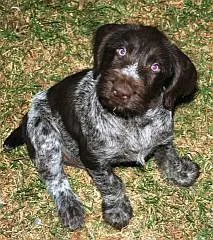
Use this German Wirehaired Pointer puppy weight calculator to predict how big your puppy will get. German Wirehaired Pointers are a sporting breed that typically reaches full size by around 12-18 months.
Enter your puppy's current weight and age to predict their adult size
Estimates based on breed growth curves. Individual dogs vary with genetics and nutrition — check with your vet for a personalized read.
Built to keep large, powerful chewers busy.
As an Amazon Associate we earn from qualifying purchases, at no extra cost to you.
| Age | Weight |
|---|---|
| Birth | 1 to 2 lbs |
| 2 Months | 5 to 11 lbs |
| 3 Months | 10 to 18 lbs |
| 4 Months | 15 to 25 lbs |
| 5 Months | 20 to 32 lbs |
| 6 Months | 25 to 39 lbs |
| 7 Months | 30 to 46 lbs |
| 9 Months | 35 to 53 lbs |
| 10 Months | 40 to 60 lbs |
| 1 Year | 45 to 67 lbs |
| 1.5 Years | 49 to 70 lbs |
| 2 Years | 50 to 70 lbs |
Estimated from typical large-breed growth curves and the German Wirehaired Pointer's adult weight range. Individual puppies vary — use the calculator above for a prediction based on your puppy's actual current weight.
New breed data, growth tips, and puppy-parenting insights, plus our free printable puppy growth tracker.
German Wirehaired Pointers are predisposed to von Willebrand disease, a genetic blood-clotting disorder that makes bleeding more dangerous — worth knowing before any surgery, since a simple blood test can screen for it. They're also prone to hip dysplasia. The breed is otherwise notably long-lived for a medium-sized dog, averaging 14-16 years.
A quality diet matched to this breed's genuinely high energy level and outdoor lifestyle; not a breed suited to minimal exercise regardless of diet.
The wiry double coat needs hand-stripping a couple of times a year to maintain its texture, plus regular brushing; the facial furnishings need occasional trimming to stay tidy.
GWPs need real daily exercise and a genuine job — hunting, agility, obedience, or serious outdoor activity. This isn't a breed suited to city apartment living without a serious commitment to exercise.
The German Wirehaired Pointer was developed in late 19th-century Germany by crossing the Pointer, Griffon, Stichelhaar, and Pudelpointer to create a rugged, all-weather gundog capable of pointing and retrieving both feather and fur, on land or in water. The AKC recognized the breed in 1959.
The breed's defining feature is its harsh, wiry, weather-resistant coat with distinctive facial furnishings (beard and eyebrows) — functional protection for a dog meant to work through heavy cover and cold water, not just a look.
