Use this Bulldog puppy weight calculator to predict how big your puppy will get. Bulldogs (English Bulldogs) are a companion breed that typically finishes filling out by around 12–18 months.
Enter your puppy's current weight and age to predict their adult size
Estimates based on breed growth curves. Individual dogs vary with genetics and nutrition — check with your vet for a personalized read.
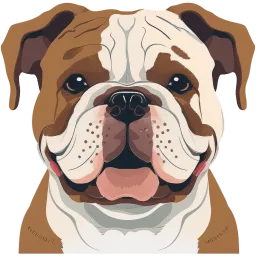
A practical pick for medium-sized breeds.
As an Amazon Associate we earn from qualifying purchases, at no extra cost to you.
| Age | Weight |
|---|---|
| Birth | 1 to 2 lbs |
| 2 Months | 6 to 10 lbs |
| 3 Months | 10 to 15 lbs |
| 4 Months | 14 to 20 lbs |
| 5 Months | 18 to 25 lbs |
| 6 Months | 22 to 30 lbs |
| 7 Months | 26 to 35 lbs |
| 9 Months | 30 to 40 lbs |
| 10 Months | 34 to 45 lbs |
| 1 Year | 38 to 49 lbs |
| 1.5 Years | 40 to 50 lbs |
| 2 Years | 40 to 50 lbs |
Estimated from typical medium-breed growth curves and the Bulldog's adult weight range. Individual puppies vary — use the calculator above for a prediction based on your puppy's actual current weight.
New breed data, growth tips, and puppy-parenting insights, plus our free printable puppy growth tracker.
Bulldogs are a brachycephalic (flat-faced) breed and nearly all are affected to some degree by Brachycephalic Obstructive Airway Syndrome (BOAS) — narrowed nostrils and an elongated soft palate that make breathing effortful and heat especially dangerous. This is a serious welfare issue, not just a cute snore; keep exercise light and always in cool conditions, and talk to a vet about surgical options if breathing is labored at rest. Skin fold infections (pyoderma) are also common — the wrinkles need to be kept clean and dry. Most Bulldog litters require a C-section due to puppies' head size relative to the mother's hips.
Because exercise has to stay light to protect the airway, portion control is essential — excess weight makes BOAS symptoms measurably worse. Feed a quality diet sized to keep your Bulldog lean rather than free-feeding.
The short, smooth coat needs minimal brushing, but the facial and body wrinkles need daily wiping and thorough drying to prevent moisture-trapped skin infections.
Bulldogs respond best to short, gentle, positive-reinforcement sessions — they can be stubborn, and their limited exercise tolerance means training should stay low-intensity and take place in cool conditions, never during heat.
The Bulldog traces back to 13th-century England, originally bred for bull-baiting — a blood sport that demanded a low-slung, powerfully built dog with a high pain tolerance. When bull-baiting was outlawed in 1835, breeders reshaped the temperament dramatically, selecting for a calmer, more docile companion while keeping the distinctive build; the AKC recognized the breed in 1886. The Bulldog is now the national symbol of Great Britain.
The AKC standard describes a dog whose disposition should be "equable and kind, resolute and courageous" — the physical toughness of the breed's bull-baiting origins paired with a temperament bred specifically away from aggression, which is part of why Bulldogs are known today as gentle, people-focused companions despite their tough appearance.
